Statistical review of personality and work engagement
How is personality linked with feeling engaged at work?
A review found group-level links, with substantial differences across studies and no proof of cause.
In this explanation
What work engagement means here
Feeling engaged at work means having energy, feeling involved and becoming absorbed in what you do. It is different from being good at a job, meeting a target or feeling satisfied with pay. Toshiki Fukuzaki and Noboru Iwata examined how this particular experience was associated with five broad personality traits.
Their paper is a meta-analysis: it combines statistical results from earlier studies. Combining studies can help reveal an overall pattern, but it cannot remove the limits of the original measurements or make a non-causal comparison into an experiment.
How the researchers built the review
The researchers searched one academic database for English-language published papers available by December 2020. Included studies involved workers and used a particular work-engagement questionnaire. The paper reports 36 included publications, although its extraction appendix has 38 numbered rows. We have not treated that as proof of 36 independent groups of workers.
They combined correlations, which describe how two measurements vary together across people. The number of available studies differed by trait. They also adjusted estimates for measurement reliability and examined possible publication bias. Some missing reliability values had to be replaced with averages from other research.
The overall pattern
Workers higher in conscientiousness, outgoingness, openness and agreeableness tended to report more engagement. Those higher in negative emotionality tended to report less. The corrected correlations ranged from about 0.27 to 0.41 in the positive direction, with negative emotionality at about −0.36.
These numbers are not percentages of motivation, chances of success or changes caused by personality. A correlation of 0.41 does not mean that 41% of a person’s engagement comes from a trait. People with the same trait score can have very different experiences at work.
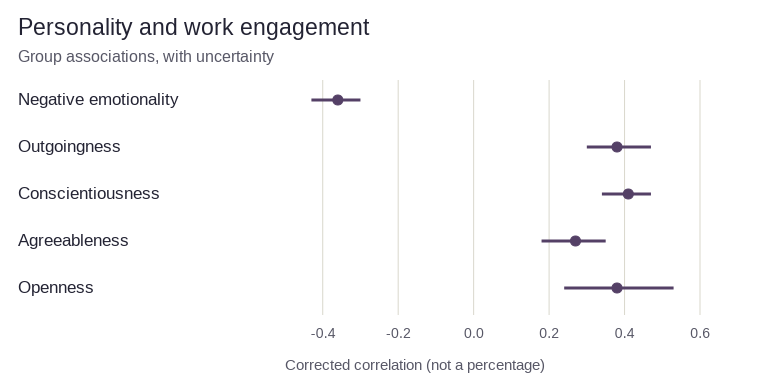
On a small screen, scroll the chart sideways. The table below shows the same values.
| Research trait | Corrected correlation | 95% confidence interval |
|---|---|---|
| Negative emotionality | −0.36 | −0.43 to −0.30 |
| Outgoingness | 0.38 | 0.30 to 0.47 |
| Conscientiousness | 0.41 | 0.34 to 0.47 |
| Agreeableness | 0.27 | 0.18 to 0.35 |
| Openness | 0.38 | 0.24 to 0.53 |
Why the pattern is less simple than a ranking
The results varied substantially across studies. Differences in jobs, samples, measures and working conditions may contribute to that variation. The overall values therefore should not be treated as exact forecasts for a particular workplace or employee.
When the researchers considered the traits together in a further model, agreeableness no longer had a clear separate link with engagement. That differs from its positive association when considered on its own. Traits overlap, so a series of separate correlations is not a list of independent effects.
The limits of the evidence
The included comparisons were cross-sectional: personality and engagement were assessed without experimentally changing a trait or following a causal process. Working conditions might influence both reports, and engagement might affect how people describe themselves. This review cannot establish that changing personality would increase engagement.
The search covered one database and English-language published research. Unpublished work and studies in other languages may differ. Statistical adjustments for missing studies are checks, not guarantees that publication bias has disappeared. The substantial variation between studies remains important.
What Corky can take from it
The review supports discussing personality as one part of a wider work experience. It does not justify hiring rankings, productivity scores or predictions of how much a person will enjoy a job. Resources, demands, leadership and the work itself still need consideration.
Corky does not directly measure work engagement. Its preference scales are also not interchangeable with every Big Five questionnaire used here. The chart and source below explain a research pattern across groups; they do not add a new engagement or performance score to an individual result.
Read the full research
For more detail, including the methods and results, follow the links to the original research below.
Toshiki Fukuzaki, Noboru Iwata (2022). Association between the five-factor model of personality and work engagement: a meta-analysis. Industrial health.
Open the original publication ↗
Read the full text in PubMed Central ↗
DOI: 10.2486/indhealth.2021-0051
This is Corky’s explanation of the research. The original authors and journal own their work. The study’s measures are not automatically equivalent to Corky’s questionnaire.