Study of married couples and how matching is measured
Do similar personalities make happier couples?
A study of 1,643 married couples shows why a personality match can look more meaningful than it is.
In this explanation
The question behind the study
It is easy to imagine that a good relationship starts with finding someone whose personality matches yours. A score that says two people are very similar can make that idea feel precise. But what does that number actually compare, and does it tell us whether the relationship is going well?
Mikhila Humbad and her colleagues examined this problem using information from married couples. Their paper asks both a relationship question and a measurement question: are similar couples happier, or can the way similarity is calculated create that impression? It is a useful distinction whenever a personality score is presented as evidence of compatibility.
What the researchers did
The analysis included 1,643 married couples with complete personality data, drawn from family studies in Minnesota. Wives averaged 43 years of age and husbands about 45. The couples had been married for nearly 20 years on average, and more than 95% of participants were White. These were mostly established marriages, rather than people deciding whom to date.
Each person completed a 198-item personality questionnaire. It covered characteristics such as positive and negative emotional tendencies, social closeness, ambition and behavioural restraint. The researchers also used a relationship-adjustment questionnaire, with two added questions about agreement on parenting. Relationship data were missing for some participants, so not every analysis used all 1,643 couples.
The team tried several ways of comparing two people’s personality scores. They also looked at how each person’s traits related to their own view of the relationship and to their partner’s view. This helped them ask whether being similar added useful information beyond the traits each person brought to the relationship.
Why the matching method mattered
Imagine two people whose profiles both show more positive than negative emotional tendencies. Their profiles might have similar shapes because that pattern is common in the wider sample. A matching score can therefore be high even when the two people are not unusually alike. In the paper, some randomly paired strangers had higher profile correlations than an actual married pair.
To address this, the researchers calculated how each person differed from the average profile for wives or husbands in the sample. They then compared those departures from the average. This asks a different question: do these two people stand out from others in similar ways? They also repeated the comparison with standardised scores.
The point is not that one calculation reveals a person’s true relationship destiny. Different calculations capture different meanings of similarity. Reporting only the most flattering number can conceal that choice. A strong-looking profile correlation is also not the percentage chance that a couple will be happy.
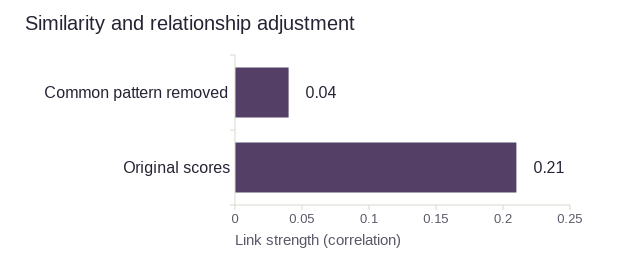
On a small screen, scroll the chart sideways. The table below shows the same values.
| How scores were compared | Strength of link (correlation) |
|---|---|
| Original personality scores | 0.21 |
| Common pattern allowed for | 0.04 |
What they found
At first, couples whose personality scores looked similar tended to give slightly better relationship ratings. The strength of this link was 0.21 on the researchers’ correlation scale. After allowing for the personality pattern that was common in the sample, the link fell to 0.04. This was so small that the study did not show a clear link using that comparison. A broader grouping of personality scores showed the same general pattern.
A correlation tells us how two measurements tend to move together across a group. It is not a person’s chance of success. A correlation of 0.21 does not mean that matching improves a marriage by 21%. Here, changing how the scores were compared made the apparent link much weaker.
The traits of each person were more useful for describing differences in relationship ratings than the matching scores. The authors therefore recommend checking the match in more than one way and taking both people’s traits into account. A single matching number can leave out important parts of the picture.
What we can learn from this
The main lesson is about caution with compatibility claims. In this sample, the apparent benefit of having similarly shaped personality profiles depended heavily on the calculation. The study does not show that every shared preference is unimportant. It did not test all the ways two people might agree about values, plans, responsibilities or everyday needs.
This does not mean that opposites make better partners. Finding little support for one kind of similarity is not proof that differences help. It also does not show that changing a personality trait would improve a relationship. The researchers compared existing couples; they did not change anyone’s personality and test what happened.
There were exceptions to the main pattern. One other way of calculating a match showed a small link when the researchers used detailed personality scores, but not when they used broader scores. The authors were cautious about that result. The paper does not justify saying that personality similarity can never matter.
The limits that matter when reading it
The sample was concentrated in long marriages, one region and a predominantly White population. Couples who had already separated were not represented in the same way as couples still married. Findings about these established couples cannot automatically be extended to new relationships, other relationship arrangements or different cultural settings.
The researchers used data that had already appeared in earlier papers. Those papers should not be counted as separate groups of people when they draw on the same families. The personality questionnaire was also different from Corky’s. This study does not show that a Corky category or matching score can predict how someone’s relationship will work.
A useful reading of the study is that a matching number needs an explanation before it deserves trust. What was measured, what counts as similar, and what the comparison group looks like can change the conclusion. The original paper below shows the calculations and the limits behind that conclusion.
Read the full research
For more detail, including the methods and results, follow the links to the original research below.
Mikhila N. Humbad, M. Brent Donnellan, William G. Iacono, Matthew McGue, S. Alexandra Burt (2013). Quantifying the Association between Personality Similarity and Marital Adjustment Using Profile Correlations: A Cautionary Tale Journal of research in personality.
Open the original publication ↗
Read the full text in PubMed Central ↗
DOI: 10.1016/j.jrp.2012.09.007
This is Corky’s explanation of the research. The original authors and journal own their work. The study’s measures are not automatically equivalent to Corky’s questionnaire.