Experiment repeated by twelve research teams
Does one demanding task make the next one harder?
Twelve research teams tested whether a hard task affects the next one. The difference was smaller than an earlier study suggested.
In this explanation
The question behind the study
After doing something mentally demanding, the next task can feel harder. One explanation is that we have a limited supply of mental energy and use some of it up. Another is that we become less willing to keep making an effort. This study checked whether performance changed after a demanding task. It did not settle why any change happened.
Junhua Dang and a large group of collaborators repeated the same experiment across 12 laboratories. Their question was whether a demanding first task would reliably reduce performance on a second task. Repeating a study in several settings helps show whether an earlier result survives beyond the circumstances in which it was first observed.
What participants did
The study started with 1,841 volunteers. Some did not complete both tasks; others were outside the planned age range. The main results used 1,775 people aged 18–30. All teams followed the same instructions, translated where needed. Each participant was put into one of two groups by chance: one did a harder first task, and the other did an easier version.
In that first task, participants named the colour of a word. In the demanding condition, the word and its ink colour usually conflicted. In the comparison condition, they matched. Naming red ink when the word says blue requires overriding the more obvious response. Afterwards, participants rated the task’s effort, difficulty, tiredness and frustration.
The second task tested whether participants could identify a briefly displayed letter while resisting a distracting cue on the opposite side of the screen. The main outcome was the error rate; the researchers also examined response time. They combined the laboratory estimates and measured several individual differences, including beliefs about willpower and self-reported self-control.
What the replication found
On average, people who did the harder first task made slightly more mistakes on the next one. The researchers put the size of the gap at 0.10 on a scale used to compare groups. This is a small difference. Their uncertainty range ran from 0.01 to 0.19. Response times also showed a small average difference, estimated at 0.10.
The earlier study that led to this repeat experiment had reported a difference of about 0.48. The new result was much smaller. These numbers describe the gap between group averages compared with the spread of people’s scores. A difference of 0.10 does not mean that everyone lost 10% of their willpower or made 10% more mistakes.
The chart below shows the uncertainty around the estimates. A dot marks the estimated gap; a line shows a range expressing how uncertain it is. The separate research teams’ results were often not clear enough on their own to show a difference. Combining their results made a small average gap easier to see.
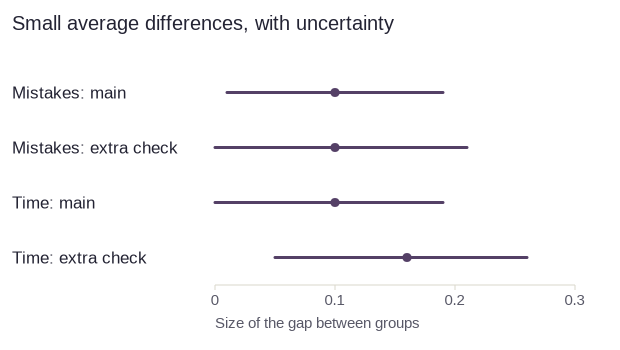
On a small screen, scroll the chart sideways. The table below shows the same values.
| What was compared | Size of gap | Range of uncertainty |
|---|---|---|
| Mistakes: main result | 0.10 | 0.01 to 0.19 |
| Mistakes: extra check | 0.10 | 0.00 to 0.21 |
| Response time: main result | 0.10 | 0.00 to 0.19 |
| Response time: extra check | 0.16 | 0.05 to 0.26 |
What changed in additional analyses
After the main analysis, the team also tried removing 340 people whose answers on the second task looked consistent with guessing. This extra check had not been planned in advance. The gap in mistakes stayed around 0.10. The gap in response times rose to 0.16. The chart keeps this extra check separate from the main result.
At first, one result suggested that people who believed willpower was unlimited were less affected on response time. That pattern did not remain clear after the extra check, and it did not appear for mistakes. The study therefore does not show that simply believing in unlimited willpower reliably protects performance.
The demanding task was rated as more effortful, difficult and tiring. Frustration did not show the same clear average difference. This distinction matters: the manipulation changed some aspects of participants’ experience, but it did not establish one uniform state that affected everyone in the same way.
What the experiment cannot tell us
Putting people into groups by chance helps researchers compare the task conditions. But finding a difference does not explain its cause. The team did not directly measure a supply of mental energy being used up. A change in effort, motivation or something else could also help explain the performance gap.
The experiment also cannot tell us how large an effect should be after hours of work, interrupted sleep, caring responsibilities or an emotionally difficult day. Its short laboratory tasks are a specific test. Suggestions in the discussion that stronger demands might produce larger effects are directions for further research, not findings established by this experiment.
Having twelve teams repeat the experiment is useful. Even so, participants were young adults willing and able to take part in these tests. The result does not represent every age or everyday situation. Using the same tasks across teams makes comparison easier, while also limiting the range of experiences tested.
Why this paper is useful
This paper shows why it matters how big a finding is, and whether it appears again. Repeating an experiment can point in the same direction as the first study while showing that the difference is much smaller. That gives us a more careful understanding than simply calling the whole idea true or false.
It also shows why we need to know which checks were planned and which were added later. A finding that appears in one check but disappears in another needs more caution. That includes appealing claims that a person’s beliefs can protect their performance.
For Corky, this is background about research on self-control. A preference for having a plan is different from performance on these attention tasks or answers to the study’s self-control questions. This paper does not let Corky give someone a willpower score or predict their productivity from a personality category. The original paper below includes the full results.
Read the full research
For more detail, including the methods and results, follow the links to the original research below.
Junhua Dang, Paul Barker, Anna Baumert, Margriet Bentvelzen, Elliot Berkman, Nita Buchholz, Jacek Buczny, Zhansheng Chen, Valeria De Cristofaro, Lianne de Vries, Siegfried Dewitte, Mauro Giacomantonio, Ran Gong, Maaike Homan, Roland Imhoff, Ismaharif Ismail, Lile Jia, Thomas Kubiak, Florian Lange, Dan-yang Li, Jordan Livingston, Rita Ludwig, Angelo Panno, Joshua Pearman, Niklas Rassi, Helgi B. Schiöth, Manfred Schmitt, A. Timur Sevincer, Jiaxin Shi, Angelos Stamos, Yia-Chin Tan, Mario Wenzel, Oulmann Zerhouni, Li-wei Zhang, Yi-jia Zhang, Axel Zinkernagel (2021). A Multilab Replication of the Ego Depletion Effect Social psychological and personality science.
Open the original publication ↗
Read the full text in PubMed Central ↗
DOI: 10.1177/1948550619887702
This is Corky’s explanation of the research. The original authors and journal own their work. The study’s measures are not automatically equivalent to Corky’s questionnaire.