Survey of why people value time alone
People value time alone for different reasons
Rest, privacy, creativity and getting things done can all matter. This study asked which purposes people valued, rather than assuming one reason for solitude.
In this explanation
The question behind the paper
Time alone can mean a quiet break, space to finish something, privacy or a chance to think. This paper asked how people differ in the reasons they value solitude. It also asked how much those priorities could be explained by broad personality traits.
The important word is value. Researchers asked how important different purposes of time alone were to people. They did not test whether time alone actually improved their health, creativity or work. A reason someone values is not automatically a benefit they receive.
How the research worked
The researchers first reanalysed two earlier samples of 741 and 801 university students. These pilot analyses used six possible purposes of solitude. Reusing those responses helped develop the question; it did not create two newly recruited samples.
The main study included 501 adults in the United States, recruited through an online research platform. Their average age was about 46. Recruitment aimed to include a range of ages, genders and ethnic backgrounds, but this was not a random sample of everyone in the country.
Participants rated the importance of 22 purposes of solitude and completed a personality questionnaire. They rated the purposes twice during the same survey. This let the researchers see how consistently people answered within that occasion. It did not show that their priorities stayed unchanged for months or years.
The biggest pattern was personal
People differed in which purposes mattered most to them. Someone might place particular value on privacy and reflection, while another person might value getting things done and enjoying nature. These combinations were more informative than assuming everyone shares the same ranking.
The researchers separated several sources of variation in the ratings. The largest component, about 46%, reflected the particular person’s rating of the particular purpose. About 22% reflected some people generally rating all purposes as more important, and about 15% reflected some purposes generally being rated more highly.
These figures describe differences among survey ratings. They do not mean that 46% of a person’s character is determined by solitude, or that a questionnaire can explain that share of someone’s life. The chart shows three selected components; smaller components and unexplained variation are not displayed.
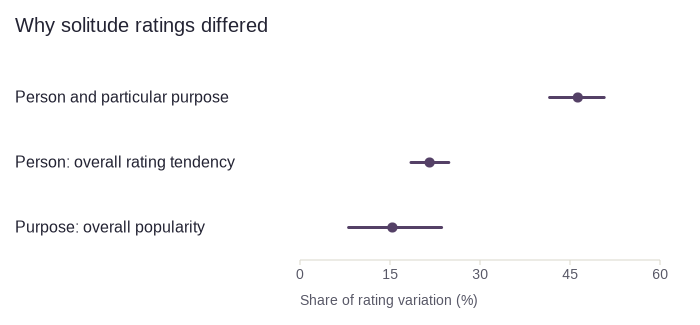
On a small screen, scroll the chart sideways. The table below shows the same values.
| Source of rating variation | Estimate (%) | 95% interval (%) |
|---|---|---|
| Person and particular purpose | 46.3 | 41.6 to 50.7 |
| Person: overall rating tendency | 21.6 | 18.5 to 24.8 |
| Purpose: overall popularity | 15.4 | 8.1 to 23.6 |
Personality explained some of the pattern
Broad personality traits related to some priorities, but they did not provide a complete explanation. After the researchers allowed for the number of comparisons they made, 10 of the 22 purposes had no retained association with any of the five broad traits.
Privacy received the highest average importance rating, yet none of the broad traits reliably explained that rating under the study’s tests. Being more outgoing was associated with lower importance placed on some quiet or calming purposes, but higher importance placed on some other purposes. There was no simple rule that outgoing people do not value being alone.
Some people who described themselves as more conscientious placed greater importance on achievement during solitude. Conscientiousness broadly concerns being careful, organised and dependable. The finding concerns what people hoped to use the time for. It does not establish that they achieved more, or that anyone else lacked ambition.
What the study cannot settle
The results came from self-reports during one survey. The same way of answering could influence both personality ratings and ratings of solitude. The set of purposes chosen by the researchers also shaped what could be found.
The main sample was from the United States, and the earlier samples were young students. People in other circumstances may use time alone differently. Caring responsibilities, available space and safety could matter, but this study was not designed to isolate all those influences.
The paper discusses possible personalised ways of supporting solitude. Those are ideas for further research, not treatments or interventions shown to work in this study. The short personality measures also cannot provide a detailed account of every individual.
A useful way to understand the result
A preference for time alone does not identify one particular need. Two people who enjoy solitude may want different things from it, and the same person may want a different kind of time alone on another day.
This research supports asking what the time is for rather than reading one motive into a personality label. It does not provide a test for deciding how much solitude someone needs or promise that spending more time alone will make them feel better.
Read the full research
For more detail, including the methods and results, follow the links to the original research below.
Dongning Ren, Wen Wei Loh, Joanne M. Chung, Mark J. Brandt (2025). Person‐specific priorities in solitude Journal of Personality.
Open the original publication ↗
Read the full text in PubMed Central ↗
DOI: 10.1111/jopy.12916
This is Corky’s explanation of the research. The original authors and journal own their work. The study’s measures are not automatically equivalent to Corky’s questionnaire.